
The 2025 Exit Interview
A year of rejection, weddings, and searching for meaning outside the market

I remember being a child and having my science teacher explain that these wriggly caterpillars in the garden would create cocoons and then emerge into beautiful butterflies. What that teacher did not disclose, perhaps rightfully so at the time, is that this involves every internal organ the caterpillar possesses melting into soup, before stitching itself back together into the butterfly. Imagine being that caterpillar, not knowing what you’re going through, and not even possessing self-awareness to know if that pain is worthwhile. That is where I write to you from.
If 2024 was a loud and external year, 2025 was an internal one. I had started the year with some anxiety, knowing that I would graduate from the arms of academia and be released back into a world. My operating model of the world was that I could finally settle down into a job that would channel my credentials (Columbia Engineering, IBM, Google, Wharton MBA) into building something useful. With this stability and job in place, I would be able to pursue other aspirations I had reserved for my thirties, such as choosing my partner and starting a family. These aspirations are not impossible. Over the course of 2025, I accrued 435 application rejections, witnessed the value of labor evaporate, witnessed the entire tech industry scramble to comprehend AI all while fueling the bubble of using it, and fundamentally, witnessed the complete dissolution of that dream.
I started my career in 2016, at a job that required me to use my Computer Science major and apply it to linguistics data used in medical databases. At the time, we worked in what was called Natural Language Processing and what has now been abused to the shorthand of “AI”. In 2025, I was emerging into a world where people believed that “AI” (large language model chatbots) could “replace humans” at every job under the sun ranging from childcare to neurosurgery. Everyone, their bosses, their grandmother and their dog needed “AI” even as MIT published data to show that nearly 95% of those investments hadn’t really gone anywhere.
With no factual reporting on employment statistics, we watched the boom of the US stock market hinge entirely on AI companies and their voracious infrastructure needs while losing any correlation to the actual economic realities of people being unable to afford groceries. Startups claimed to build “superintelligence” and “Artificial General Intelligence”, while absolutely none of them bothered to tackle the environmental cost of such intelligence. In 2025, we lost the notion of intelligence precisely because we kept using the label of Artificial Intelligence to explain away what is humans dehumanizing the merit of labor.
I was being rejected for not having enough experience, for not having more traditional experience, for being too technical for Strategy roles, for having dared to get a business degree during the Advent of AI. Relational skills were no longer necessary because “AI could do it” and technical skills were no longer necessary because “AI will be able to do it”. I was told to forget my $250K MBA and “just apply to engineering roles” at a time of record layoffs within the tech industry. Companies justified these due to AI replacement, but I also believe that many were justifying cost-cutting anyway and using AI replacement to justify the practice. Job descriptions in AI seemed even more vague than before because Product Managers or Technical Program Managers vary in responsibility from team to team, and now every job had AI in the title. Please help me parse what exactly this job is:
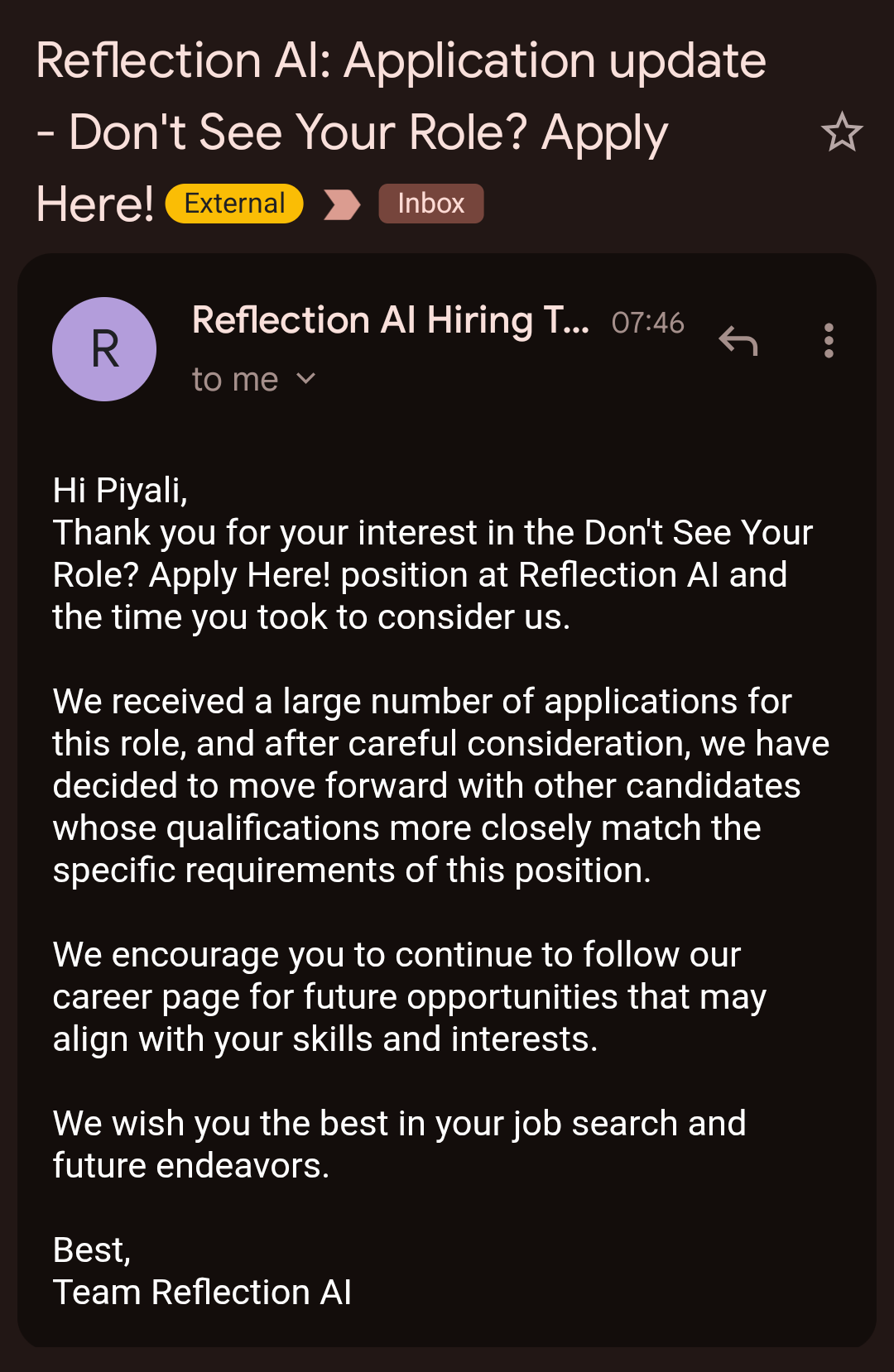
One of the highest and most validating compliments I received this year was, “You are not delusional.” I couldn’t shake off the deep anxiety that I was riding a hype bubble even in the few calls that did convert to actual interviews. When I was rejected from my final round for a Solutions Architect Go-To-Market role at one of the frontier AI companies (their models power half the AI tools you’ve heard of), I was hollowed out but also relieved. Because I don’t think I would have been able to convince enterprise-class customers to abandon their existing jobs and become prompt engineers.
I won second place at a hackathon with a team of young Stanford CS undergrads, and the experience convinced me that the children, as they say, are cooked. Many kids struggled to debug their own AI-generated code, and it felt like they were incapable of doing anything (making slides, identifying errors, etc.) without an AI doing it first. In the late Cretaceous period (2015), all we had was StackOverflow, Redbull and the tenacity for manual combat with the compiler. Now, we’re living in a time when we have abstracted away the “process” of labor under AI (be that creative work, technical work, relational work) in order to make outcomes happen faster and more “cheaply”, but damn, what fraction of those outcomes are actually useful or sustainable? I’m not saying that the underlying Machine Learning technology is futile, especially not after building my entire career on it, but surely we all need to dig past the chatbots and bring real engineers and mathematicians to their jobs again?
During this time, my social circle shrank rapidly. I taxed the abilities of Linkedin, of Simplify, of my friends at Google, of my friends at Wharton, of my enemies on Linkedin. Even my ex who broke up with me in January helped me get an interview at a tiny AI startup that didn’t find my 8 years of technical experience sufficient. I also chose to isolate myself because I no longer had an answer to “what’s next.” Someone I considered a friend told me that my extremely hard-earned MBA was useless because “well what’s the point of it, if it didn’t get you a job?” Men who digitally catcalled me on Instagram had the audacity to look me up on Linkedin and ask me why I hadn’t merely returned to my former employers. Someone joked that I must have been blacklisted and that’s why my credentials couldn’t get me callbacks. My parents finally enforced a VPN-block on Linkedin at home (yes, the kind that stops people from browsing Pornhub at work), so that I would stop using the Apply button as a means of self-harm.
2025 revealed to me that I had tethered a non-trivial portion of my self-esteem and self-identification with my work, and with my resume. James Baldwin said that he does not dream of labor, but I do. Work gives me purpose because it helps define my role in society and what I am expected to contribute in exchange for my benefits for participating in it. One of my fundamental toxic tenets is that I can justify taking up space in the world as long as I am useful. And I endured a year where I was told 435 times explicitly but many more times implicitly that I was no longer of value. I am no longer a caterpillar, and my idea of the butterfly ceased to exist.
In 2025, I kept asking myself who I was when I was not an economically contributing member to society and more painfully, what have I done with a decade of my life if all of those hard-earned accomplishments were being rendered futile? A friend told me, “Piyali, that is a fuck-all dystopian question to ask.” But that didn’t stop me, quite like these agentic LLMs, from thinking longer for a better answer. In 2025, The phrase “free fall” appears in my journals 43 times this year, but every free fall has to stop, and good lord have I wanted 2025 to stop.
But even decay doesn’t just stop there. Even in death, whales become ecosystems of life. Even in ruins, new civilizations are founded. Even in total and complete darkness and silence, it is physically impossible for any part of the universe to be at absolute zero (0 Kelvin). I may be uniquely special enough to be rejected from every possible employer and every prospective partner, but I am not excluded from the second law of thermodynamics.
Even in this year of rejection, I could not stop metabolizing.
The few genuine friends who checked in with me this year were my anchors. You know who you are and I thank you for your service. They let me cry into their arms, phones, dumplings, dms, as they had sparse means of comfort themselves. One grappled with the risk of deportation because they were unemployed under the H1-B visa status, and immediately needed emergency surgery that would render them immobilized for weeks. Another was fighting for their fledgling startup all while their family was separating. Another grappled with interview prep materials with me while their high school classmates were carried out in bodybags from war-zones. Another friend between interviews described a psychotic break where they had to be physically restrained from accessing windows in a psychiatric facility, and their words stayed with me forever. “I knew I was insane, but I was not stupid.” We were in a Pandemic of Unemployment, only everyone had a uniquely bad disease.
I don’t know how I dared to seek community in a time when I was carrying my entire sense of self like an open wound, but despite myself, I was invited to ten weddings in 2025 (a record high from having attended exactly one in my twenties). I declined three due to scheduling conflicts, not including one from an ex who had invited me to his wedding (?!), and one that has been postponed. I also somehow achieved the personal affront of being disinvited 48 hours before a wedding that I had received an enthusiastic invitation for, because “it would just be better if you didn’t show up.” This resulted in me having to sever a 22-year long friendship in one night.
Someone asked me if attending all these weddings as a single woman made me feel jealous or lonely, but honestly, I was left in awe of the gravity of human ceremony. A wedding was not merely a ceremony for two people as much as the merging of two families witnessed by their entire shared worlds. A wedding was a complex logistics endeavor requiring the patience, skill and talents of an entire production crew worthy enough to put on a resume. We were gathered there to celebrate how, in a world of misinformation, the illusion of choices, ambiguity, and uncertainty, people were affirming responsibility to care.
At these weddings, I noticed how some of my childhood friends started to resemble their parents, which often led to a jarring reminder of how much older their parents looked compared to my childhood memory, and consequently how much older my own were becoming. We used to be girls, kids fighting over who got computer time and now some of us are whole wives, husbands and parents. And you know, before they became commercialized demographics, they were non-economical definitions of person.
In 2025, I fought violently to make my soupy form legible to myself. I tried to use AI as a fashion advisor, given my notoriety for making spreadsheets. I throttled my time spent on Instagram (it wasn’t a timer but it was disabling notifications that helped), and I refused to announce my sabbatical. I started a media spreadsheet where I documented not only every movie I watched or book I read, and every instagram reel I consumed or substack I read (yes it’s that long). I started a perfume spreadsheet to identify what kinds of smells gave me headaches and which ones didn’t, and I fell into a rabbithole about the anosmia of Iso-E. I was taking the mundane mechanics of my labor (organizing, researching, sorting) to transmute the inherently meaningless soup of my life into something that could be analyzed.

I wanted to be given a definition so badly that I rejoiced when both ChatGPT (with long memory) and Claude (then memoryless) were able to look at these datasets and converge on the same definition of Person. LLMs are just mirrors that regurgitate what you feed them, but like mirrors they can be simultaneously confronting and flattering. A human therapist would probably have been able to entangle the core fear of my meaninglessness, but the machines struggled to retain 300-row CSVs in memory, and their responses approximated what they thought the right tone of emotional response should be (GPT flatters, Claude overcorrects). Have the LLM providers considered that procrastination could also be a revenue-generating enterprise-class use case?
When everything that has held meaning is being abstracted away to oblivion, I needed to strip everything down to its basics. I took a class that was focused on studying and cultivating creative practices and instincts, and instead started to study the drawings of Mathilde Crétier. An AI could definitely make these so the output itself was less important to me than the knowledge of how my hand is capable of understanding and rendering light. I was being taught the slow lesson that even knowledge has a cyclic property to it, in that skills once adapted to may find accidental utility again.
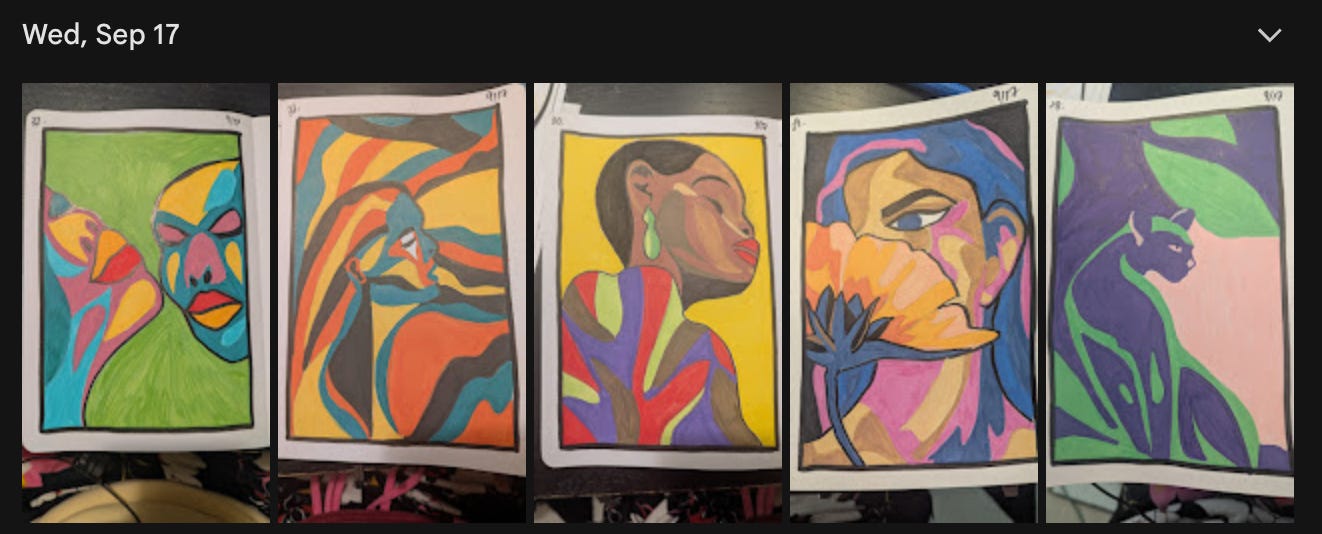
The class also contributed to changing my relationship to the colors I wear. For the first time in my life, I stopped wearing silver jewelry entirely and incorporated a record number of brown items into my closet (uptick of 22%). I learned about David Kibbe’s fashion archetypes and that I’m a Soft Dramatic, which privileges conspicuous architectural statuesque silhouettes so I decided to take a break from free-flowing, Bohemian, miniskirts and minidresses for a while. (Can you see my naked grasp for structure even in the realm of the physical?)
And I could not control myself in structured, strategized environments. I played chess, not as an intellectual sport but like a first-person-shooter game. I derived more joy from gobbling up pieces on the chessboard until 3AM than actually trapping the King in a checkmate. I tried to read Gödel’s Proof of Incompleteness in an effort to feel something. I tried to write a romance novel as a satirical project that became too real for me to even finish. I committed Bohr’s derivation to memory. Instead, meaning came to me through things like this:
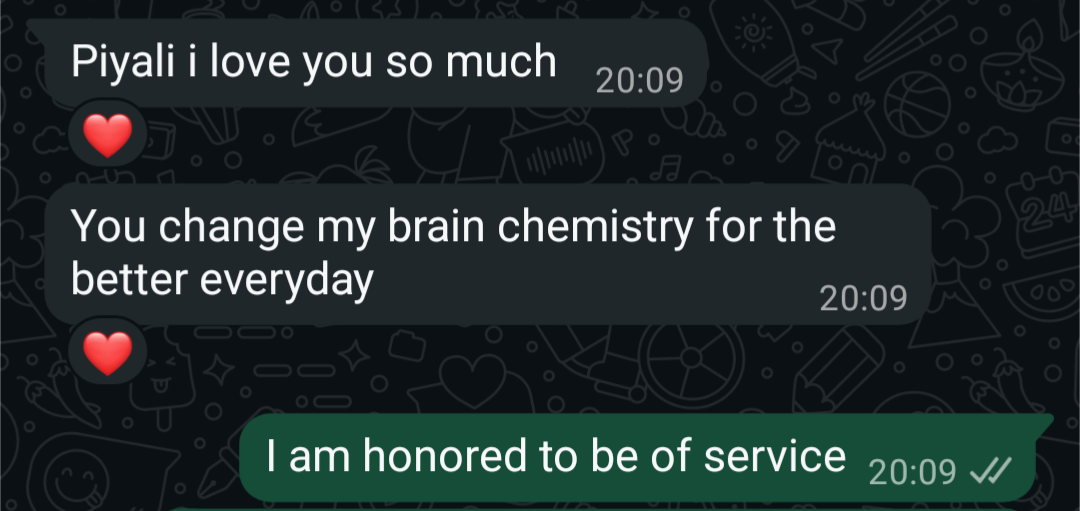
I wish I could end this year by describing what the completed end state of this year, of myself, of the experiences I endured looks like. The gift of experiencing primordial chaos is that we are spared of sentience when it’s happening. The caterpillar does not have to justify its pupa stage on a resume and make a Linkedin post about its chrysalis being a productive exercise. What if I’m not a butterfly but instead a monster? I don’t know what the future holds (mortal dread) but I also don’t know what the future holds (joy). I started this essay by talking about caterpillars, and you know what they have? One limb to go on.
Great read! Cathartic, profound and funny - everything I remember about your writing :)
This article comes at the perfect time; how do we truly rebuild purpose after such a profund chrysalis moment, your insights are truly brilliant.